How Much Does SMS Marketing Cost? Real Monthly Budgets
Published Sept 2026. How much does SMS marketing cost? With SlickText, a business with 2,500 subscribers that sends two short campaigns a month spends about $190 a month, before taxes: $169 for the plan and $21 in carrier fees. That’s roughly 3.8 cents per message, all in. Smaller lists spend less in total but more per message, and larger lists spend more in total but less per message.
Your own cost depends on how many messages you send, how long they are, whether they include images, and what kind of number you send from. Below, we break down each cost, build that 2,500-subscriber budget step by step, and show what the math looks like for a small sender and a high-volume one.
All SlickText prices and carrier fees in this post are current as of September 2026.
The four parts of an SMS budget
Almost every SMS bill comes down to four things: your plan, your message volume, carrier fees, and extras like sending numbers and registration. Volume is the biggest variable. A business sending a few hundred texts a month and one messaging 50,000 subscribers several times a month are working with completely different budgets.
Some platforms also add a separate platform fee on top of message costs. SlickText doesn’t. Other providers may charge extra for more users, more contacts, incoming messages, advanced features, or additional keywords. SlickText includes all of these in every paid plan.
Platform plans
SMS platform pricing is typically done in one of three ways. All three charge for message volume. What differs is what else they charge for.
Message volume only. You pay for a set number of message credits each month, and that’s the only thing that changes between plans. Every feature is included at every level, and the size of your list doesn’t affect the price.
Contact volume plus message volume. You pay for the size of your list as well as the messages you send. This model is common on platforms that started in email marketing. Your price rises as your list grows, even in months when you send less.
Features plus message volume. Plans are tiered by features as well as credits. Tools like automations, integrations, segmentation, or API access may be reserved for higher tiers, so you can end up upgrading for a feature rather than for more messages.
The right model depends on how you send. If you have a large list you text only occasionally, contact-based pricing means paying for everyone on the list every month. If you need one feature from a higher tier, feature-based pricing can mean paying for credits you won’t use. With message-volume-only pricing, the only question is how much you send. Whichever model you’re looking at, compare the total you’ll pay each month, not just the per-message rate.
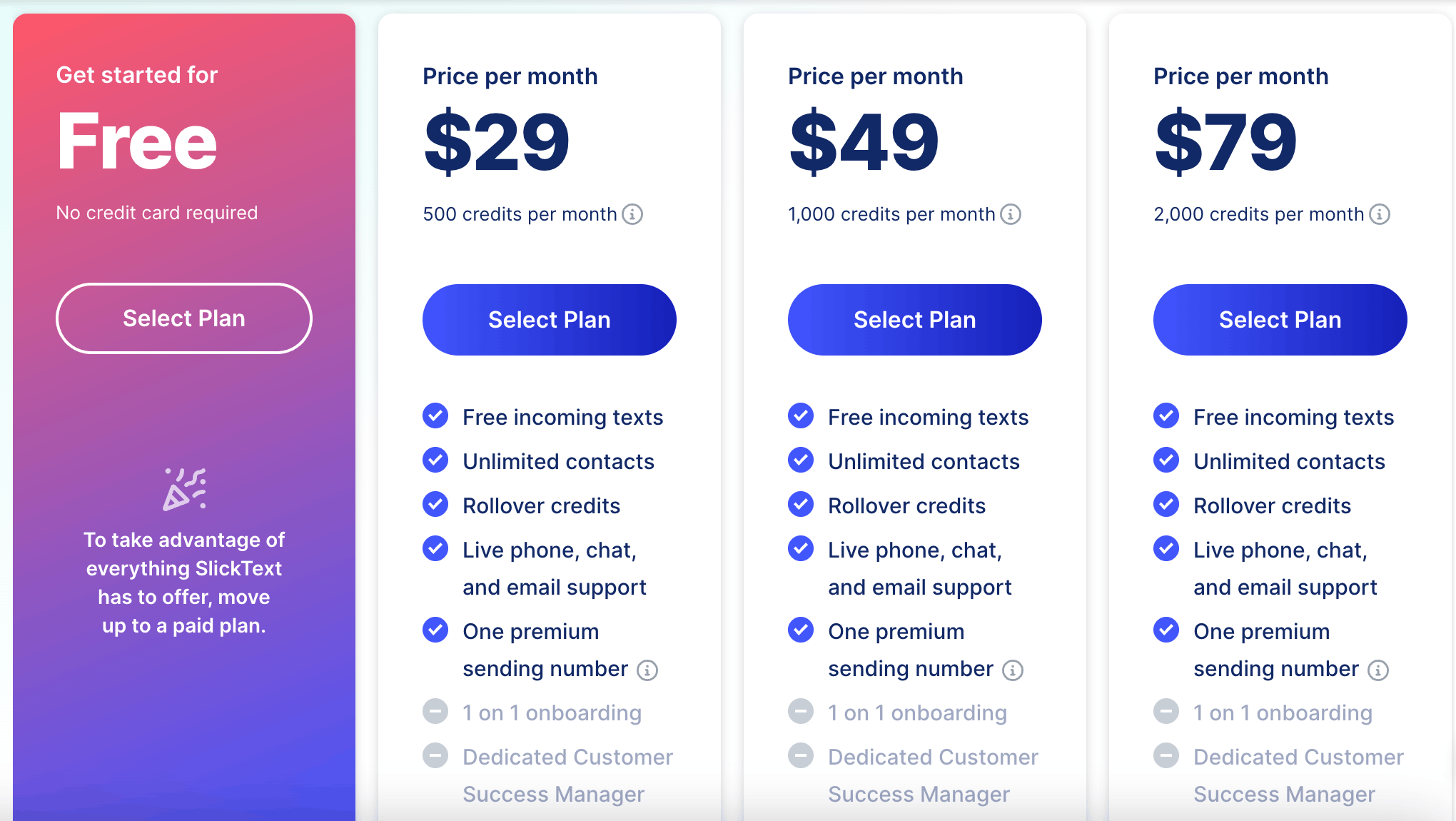
SlickText uses message-volume-only pricing, billed monthly or annually. Every plan includes every feature and unlimited contacts, so your price changes only when your sending does. Here are the monthly prices:
| Monthly plan | Included message credits |
| $29/month | 500 credits |
| $49/month | 1,000 credits |
| $79/month | 2,000 credits |
| $129/month | 3,500 credits |
| $169/month | 5,000 credits |
| $319/month | 10,000 credits |
| $579/month | 25,000 credits |
| $939/month | 50,000 credits |
On the $29 plan, carrier fees add at most $2.10 a month for standard U.S. texts, for a total of $31.10
Once you sign up for a free trial or a paid plan, more plan sizes open up in your account: 7,500, 15,000, 20,000, 30,000, 35,000, 40,000, and 45,000 credits a month. That lets you match your plan to your actual volume instead of jumping to the next tier in the table above. Custom plans are also available for businesses of any size whose needs don’t fit a standard tier.
Every paid SlickText plan includes the full platform, unlimited contacts, unlimited users, unlimited keywords, free incoming messages, live support, and a toll-free sending number.
Plans at $129/month and above include a free 1-on-1 onboarding session with our client success team, and plans of 50,000 credits and above include a dedicated Customer Success Manager.
Rollover credits. Unused credits roll over for one full billing term following the billing date: one month on monthly plans, one year on annual plans. On a monthly plan, a light month gives you a cushion for a busy one. On an annual plan, a year of rollover is genuinely valuable for seasonal senders: credits you don’t use in a slow spring are still there for your holiday rush.
Annual plans. Paying annually saves 16.67%, the equivalent of two months free.
When you compare providers, check whether features, users, or support change as you move between tiers. With us, platform features stay the same on every plan, and only message volume changes. Not every provider works that way.
What counts as one message
A text that shows up as one message on a customer’s phone isn’t always one billable message. Providers bill by segment, and segment length depends on which characters you use.
| Encoding | What triggers it | Characters in a single segment | Characters per segment in a longer message |
| Standard (GSM) | Letters, numbers, and common punctuation only | 160 | 153 |
| Unicode | Any emoji, curly quotation mark, em dash, or other special character | 70 | 67 |
It takes just one special character to switch the whole message to Unicode.
A few standard characters also count double. The characters € [ ] { } ~ \ ^ and | are part of the standard set, so they don’t switch the message to Unicode, but each one takes up two characters of space. A message containing a pair of square brackets has room for only 156 other characters in a single segment.
Here’s what that looks like in practice. In both examples below, one small change doubles the cost.
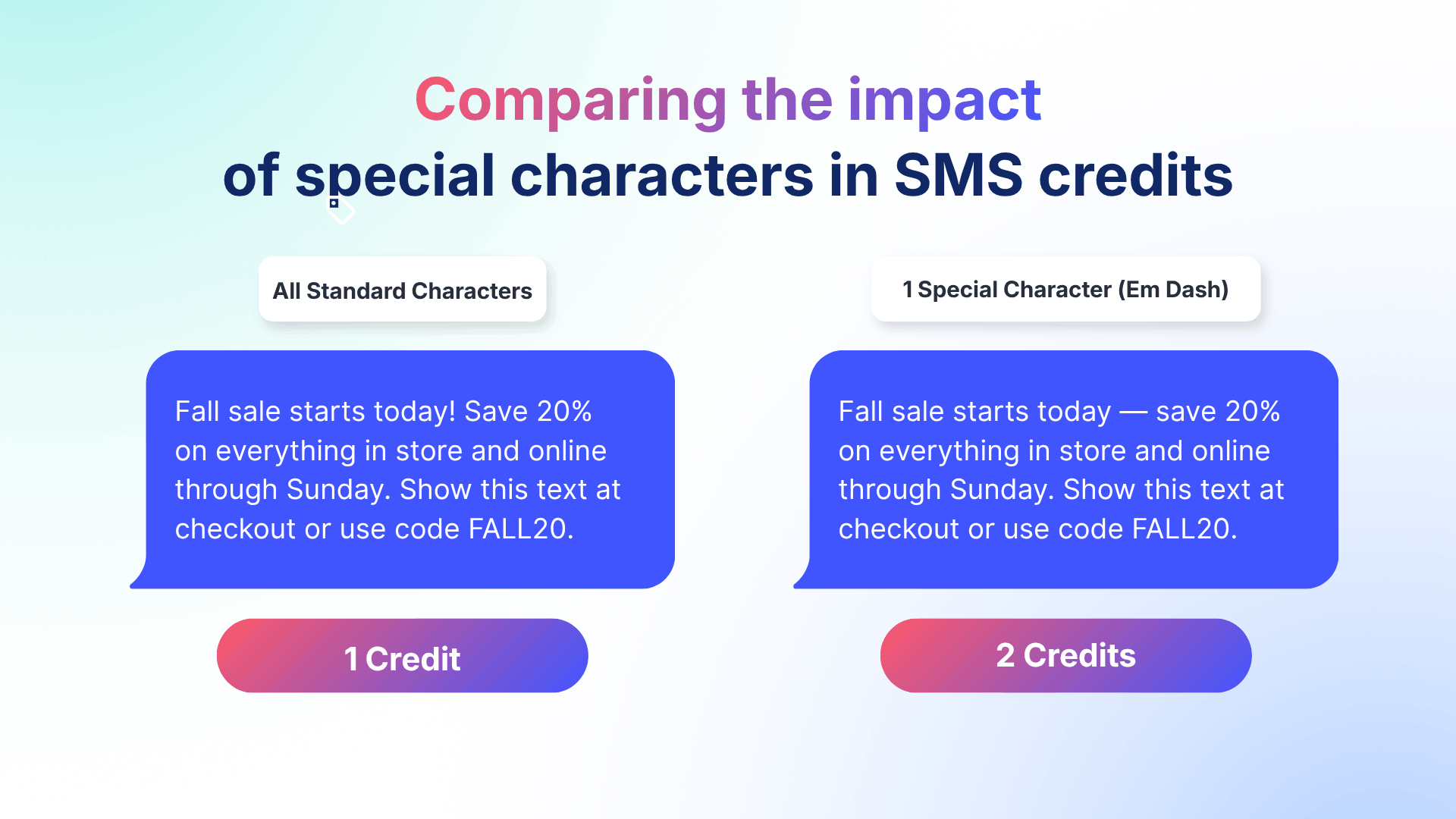
Example 1: an em dash
Fall sale starts today! Save 20% on everything in store and online through Sunday. Show this text at checkout or use code FALL20.
This message is 129 standard characters, so it’s one credit per recipient. Now swap the exclamation point for an em dash:
Fall sale starts today — save 20% on everything in store and online through Sunday. Show this text at checkout or use code FALL20.
The length barely changes, but the em dash switches the message to Unicode, where the 70-character limit applies. It now takes two credits per recipient. Sent to 2,500 subscribers, that’s 5,000 credits instead of 2,500.
Example 2: an emoji
Your order has shipped! Track it anytime at the link in your account.
At 69 characters, this is one credit. Replace the exclamation point with a package emoji:
Your order has shipped 📦 Track it anytime at the link in your account.
The emoji switches the message to Unicode and counts as two characters, bringing the total to 71. That’s just over the 70-character limit, so the message now takes two credits.
Because carrier fees are charged per credit, they double too.
Using AI to write your texts? Watch for em dashes. You can absolutely use AI tools like Claude, ChatGPT, or our built-in AI Compose to draft your messages. But AI writing often includes em dashes. Before you add AI-written text to your message, replace any em dashes with hyphens or commas so they don’t double your credit usage.
SlickText shows how many credits a message will use before you send it, so you can catch this before it happens.
MMS costs more
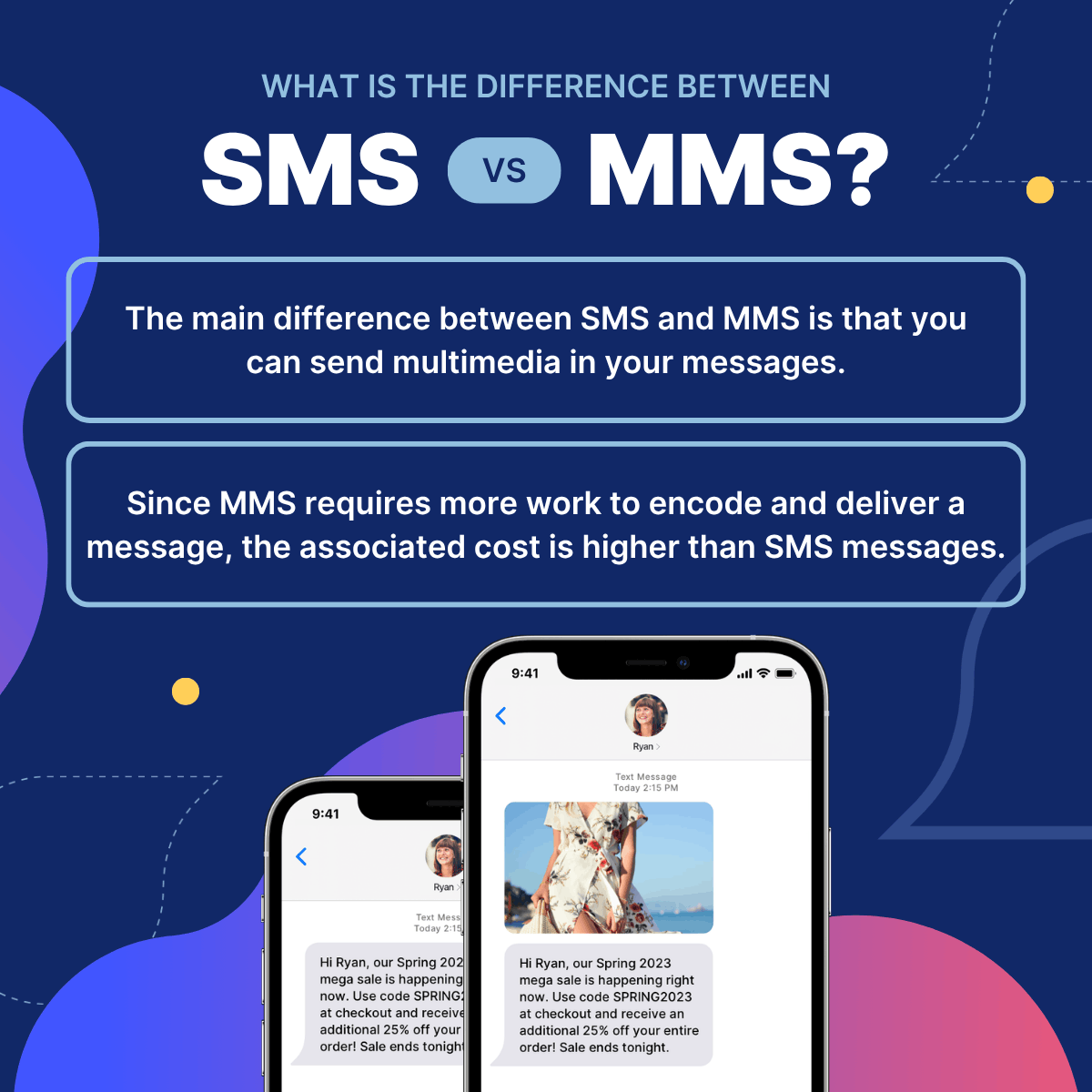
Messages with an image or other media are sent as MMS. Here’s the credit breakdown at SlickText and most other MMS marketing platforms:
| Message type | Credits |
| One standard SMS segment | 1 |
| One MMS message (up to 1,600 characters) | 3 |
| Incoming message | 0 |
Tip: If you’re past two credits, add an image. Once an SMS needs three or more segments, an MMS costs the same or fewer credits. That happens at more than 306 standard characters, or more than 134 characters if the message contains an emoji or other special character.
- At three segments, the credits tie, but a single MMS carrier fee costs less than three SMS carrier fees. At U.S. rates, that’s $0.0087 versus $0.0126, and the same holds for Canadian short codes.
- Beyond three segments, MMS wins on both.
An MMS holds up to 1,600 characters for a flat 3 credits. The same 1,600 standard characters sent as SMS would take 11 credits. Below three segments, plain SMS is the cheaper option.
A sample monthly budget
Take a business with 2,500 subscribers that sends two promotional campaigns a month, each short enough to fit in one standard segment.
2,500 subscribers × 2 campaigns × 1 segment = 5,000 credits
That fits our 5,000-credit plan at $169/month.
Add carrier fees
Wireless carriers charge a fee for each message sent on their networks. Because you send to many different carriers and each carrier’s fee is slightly different, we use a blended model for charging these fees. We pass these through at cost, with no markup. SMS carrier fees are charged per message credit, so a message that uses two credits incurs the fee twice. MMS carrier fees are charged per message.
| Message Type | Carrier Fee for U.S. Toll-free, 10DLC, and Short Code | Carrier Fee Canadian Short Code |
| SMS | $0.0042 per credit | $0.0050 per credit |
| MMS | $0.0087 per message | $0.0130 per message |
These costs have been verified as of September 2026. If wireless carriers change their fees, we may update the blended carrier rates to align. To confirm the latest fees, check out our help center article on understanding carrier fees.
For this business, sending in the U.S.:
5,000 × $0.0042 = $21
This budget sends every campaign to the full list, so treat it as the upper end. Segmenting your campaigns lowers the total.
We charge carrier fees in arrears. At the end of each period, we count the credits you used for SMS and the messages you sent as MMS, then apply the rates above. Your first payment won’t include carrier fees if you haven’t sent any messages yet. On monthly plans, carrier fees appear on your monthly invoice. On annual plans, they’re charged every 30 days.
| Expense | Estimated monthly cost |
| 5,000-credit plan | $169.00 |
| Carrier fees | $21.00 |
| Estimated monthly total | $190.00 + applicable taxes |
That works out to about 3.8 cents per message, including the subscription and carrier fees. That’s a more useful number for budgeting than the plan price alone.
Don’t forget the messages you didn’t plan
This budget uses exactly 100% of the plan, which leaves no room. In reality, this business will also send automated texts to new subscribers, welcome messages, and possibly an extra promotion. If it gains 150 subscribers in a month, their confirmation and welcome texts alone add about 300 credits.
That’s why we recommend budgeting 10–20% above your campaign volume. The next section covers what happens when you go over.
What happens when you go over
Some platforms automatically bill overage charges. Others make you buy more messages or upgrade.
With SlickText, you’ll get an alert when your balance runs low. You can then reach out to our team to buy bulk credits or upgrade your plan. If you run out, messages won’t send. You’ll never get a surprise overage charge. Rollover credits from lighter months also count toward your balance.
How MMS changes the budget
Now suppose the same business sends one SMS campaign and one MMS campaign with an image:
- SMS: 2,500 × 1 credit = 2,500 credits
- MMS: 2,500 × 3 credits = 7,500 credits
- Total: 10,000 credits
That moves the business to the $319/month plan. MMS carrier fees are also higher, at $0.0087 per message for U.S. sending.
| Expense | Estimated monthly cost |
| 10,000-credit plan | $319.00 |
| 2,500 SMS carrier fees | $10.50 |
| 2,500 MMS carrier fees | $21.75 |
| Estimated monthly total | $351.25 + applicable taxes |
One image nearly doubled the monthly cost. MMS is often worth it when visuals help sell the offer or a longer character count is necessary, but your content choices should be part of your budget from the start.
What the budget looks like at other sizes
The same math works at any list size. What changes is the cost per message: the more you send, the less each message costs.
A small sender: 750 subscribers
A business with 750 subscribers sending two one-segment campaigns a month needs 1,500 campaign credits. Adding a 10–20% buffer puts it at 1,650 to 1,800 credits, which fits the 2,000-credit plan at $79/month.
Carrier fees: 1,500 × $0.0042 = $6.30
Total: $85.30/month, about 5.7 cents per message. The 500 spare credits cover opt-in confirmations and welcome texts, and whatever’s left rolls over.
A high-volume sender: 25,000 subscribers
A business mass texting 25,000 subscribers sending two one-segment campaigns a month needs 50,000 campaign credits. That matches the 50,000-credit plan at $939/month, which also includes a dedicated Customer Success Manager.
Carrier fees: 50,000 × $0.0042 = $210
Total: $1,149/month, about 2.3 cents per message. At this volume, the 10–20% buffer means planning for 55,000 to 60,000 credits. That means adding bulk credits or talking to us about a custom plan.
| Business | Credits per month | Plan | Carrier fees | Estimated monthly total | Cost per message |
| 750 subscribers, 2 campaigns | 1,500 | $79 (2,000 credits) | $6.30 | $85.30 | ~5.7¢ |
| 2,500 subscribers, 2 campaigns | 5,000 | $169 (5,000 credits) | $21.00 | $190.00 | ~3.8¢ |
| 25,000 subscribers, 2 campaigns | 50,000 | $939 (50,000 credits) | $210.00 | $1,149.00 | ~2.3¢ |
All totals are before applicable taxes and use U.S. carrier fees.
What a campaign has to earn to cover its cost
To break even, your texts need to bring in enough profit to cover the monthly total. The formula:
Monthly SMS cost ÷ profit per sale = sales needed to break even
Take the $190 budget above. If each sale brings in $25 in profit:
$190 ÷ $25 = 7.6, so 8 sales a month, or 4 per campaign
If each sale brings in $10 in profit:
$190 ÷ $10 = 19 sales a month, or 10 per campaign
You can also look at it per message. At 3.8 cents per message, each of the 5,000 messages needs to return 3.8 cents in profit on average for the program to pay for itself. Use profit, not revenue, and plug in your own numbers. Your margins decide the answer.
Other costs to check
Sending numbers and registration. Carriers require businesses to register their sending number. Here’s what each option costs at SlickText:
| Sending option | Ongoing cost | Registration |
| Toll-free number | Included with paid plans | $0 |
| 10DLC number | $10/month | $44 |
| Short code (random or vanity) | $500/month for random short code
$1,000/month for vanity short code |
$1,000 |
| RCS messaging (includes Verified Sender Profile) | $200/year | $500 |
Number registration fees go to the wireless carriers and the U.S. Short Code Registry. SlickText does not keep any portion of number registration fees.
Most small and midsize businesses don’t need a short code, but high-volume senders sometimes find the extra throughput worth it.
If a registration is rejected or stalls, our messaging operations team takes the case and works with you to obtain approval, regardless of plan size, including the $29 plan.
Users and features. Some platforms charge per seat or reserve automations, integrations, segmentation, signup forms, analytics, or API access for higher tiers. All of these are included in every SlickText plan.
Incoming messages. Two-way conversations can generate significant inbound volume. We don’t charge for incoming texts, but other providers may.
Taxes. Applicable taxes are added depending on your location.
Estimate your own budget
Start with this formula:
Recipients per campaign × campaigns per month × segments per message = campaign credits
Then add automated messages, add a buffer, and pick the smallest plan that covers the total.
Say you have 4,000 subscribers and send two one-segment campaigns a month to your full list:
4,000 × 2 × 1 = 8,000 credits
Add automated workflows. If 250 new subscribers each get a two-message welcome series:
250 × 2 = 500 credits
Total: 8,500 credits per month
Add a 10–20% buffer for opt-in confirmations and extra sends, and you’re looking for 9,350 to 10,200 credits.
The 10,000-credit plan covers that at $319/month, with about an 18% buffer.
Carrier fees: 8,500 × $0.0042 = $35.70
Total: $354.70/month, about 4.2 cents per message. Any of the 1,500 spare credits you don’t use roll over for one billing term.
If your total lands between tiers, more plan sizes open up once you’re a subscriber.
Count recipients, not subscribers. Most campaigns shouldn’t go to your whole list. A restaurant promotion might go only to guests who’ve visited in the last 90 days, and a restock alert only to people who viewed that product. With segments, you send each campaign to the audience it’s actually for, and you pay only for those messages. If one of the two campaigns above went to 1,500 subscribers instead of all 4,000, campaign credits would drop from 8,000 to 5,500.
Quick checklist before you choose an SMS marketing platform
- What counts as one message, and how are long or emoji-containing texts billed?
- What does MMS cost in credits and carrier fees?
- Are carrier fees included, passed through at cost, or marked up?
- What do additional credits cost, and do unused credits roll over?
- Are incoming messages, users, and key features included?
- What sending number is included, and what are the registration fees?
- Is live support included for every plan or only premium customers?
The bottom line
With SlickText, a business sending two short campaigns a month can expect to spend about $85/month with 750 subscribers, $190/month with 2,500, and $1,149/month with 25,000, all before taxes. Images, longer messages, more frequent sends, or a growing list will push those numbers up.
Build your budget around realistic usage. Count segments rather than messages, include carrier fees, leave room for growth, and know what extra messages will cost before you need them.
Frequently asked questions about SMS marketing costs
How much does SMS marketing cost per month?
SlickText plans start at $29/month for 500 message credits, plus carrier fees. If you use all 500 credits on standard U.S. texts, carrier fees add $2.10, for a total of $31.10/month before taxes. Your cost grows with how many messages you send: two short campaigns a month to 2,500 subscribers runs about $190.
How much does SMS marketing cost per message?
In our examples, the all-in cost runs from about 2.3 cents to 5.7 cents per message, including the subscription and carrier fees. The more you send, the less each message costs.
What is an SMS segment?
A segment is the unit providers bill by. A standard message fits 160 characters in one segment, and longer messages split into segments of 153 characters. Each segment uses one credit.
Do emojis cost more to send in a text message?
Often, yes. One emoji switches the whole message to Unicode, which drops the single-segment limit from 160 characters to 70. A message that was one credit can become two.
Can an em dash double the cost of a text?
Yes. An em dash, like an emoji or curly quotation mark, switches the message to Unicode and its 70-character limit. AI writing tools use em dashes often, so replace them with hyphens or commas before sending.
How much does an MMS message cost?
At SlickText, one MMS uses 3 credits and holds up to 1,600 characters. The U.S. carrier fee is $0.0087 per MMS message, and $0.0130 for Canadian short codes.
When is MMS cheaper than SMS?
Once an SMS needs three or more segments. That’s more than 306 standard characters, or more than 134 if the message contains a special character. At three segments the credits tie, and the MMS carrier fee is lower.
What are carrier fees?
Carrier fees are charges from wireless carriers for messages on their networks. SlickText passes them through at cost, with no markup: $0.0042 per SMS credit in the U.S. and $0.0050 for Canadian short codes. They’re billed in arrears, after you send.
Are incoming text messages free?
At SlickText, yes. Incoming messages use 0 credits on every plan. Other providers may charge for them.
What happens if I run out of message credits?
With SlickText, messages stop sending. You won’t get a surprise overage charge. You’ll get a low-balance alert first, and you can buy bulk credits or upgrade your plan.
Do unused SlickText credits roll over?
Yes, for one full billing term following the billing date: one month on monthly plans, one year on annual plans. Annual rollover is especially useful for seasonal senders.
How much does a 10DLC number cost?
At SlickText, a 10DLC number costs $10/month plus $44 for registration. Registration fees go to the carriers, and SlickText keeps no portion of them.
How much does a short code cost?
A short code runs roughly $500 to $1,000/month at SlickText, plus $1,000 for registration. Most small and midsize businesses don’t need one.
Is a toll-free number included with SlickText?
Yes. Every paid plan includes a toll-free sending number, with $0 registration.
How do SMS marketing platforms price their plans?
Every platform charges for message volume, and some also charge for list size or features. Contact-based plans cost more as your list grows, even in months when you send less. Feature-tiered plans reserve tools like automations or integrations for higher tiers. SlickText uses message-volume-only pricing: every plan includes every feature and unlimited contacts, so your price changes only when your sending does.
How do I estimate my SMS marketing budget?
Multiply recipients per campaign by campaigns per month by segments per message, then add automated messages. Budget 10–20% above that total to cover opt-in confirmations, welcome texts, and extra sends.
Does SlickText charge more for users or features?
No. Every plan includes every feature, unlimited users, and unlimited contacts. Only message volume changes. Plans at $129/month and above add a free onboarding session, and plans of 50,000 credits and above add a dedicated Customer Success Manager.